
years - average UK car age
roughly fail their first MOT
a full vehicle report
Start at your desk, before you view
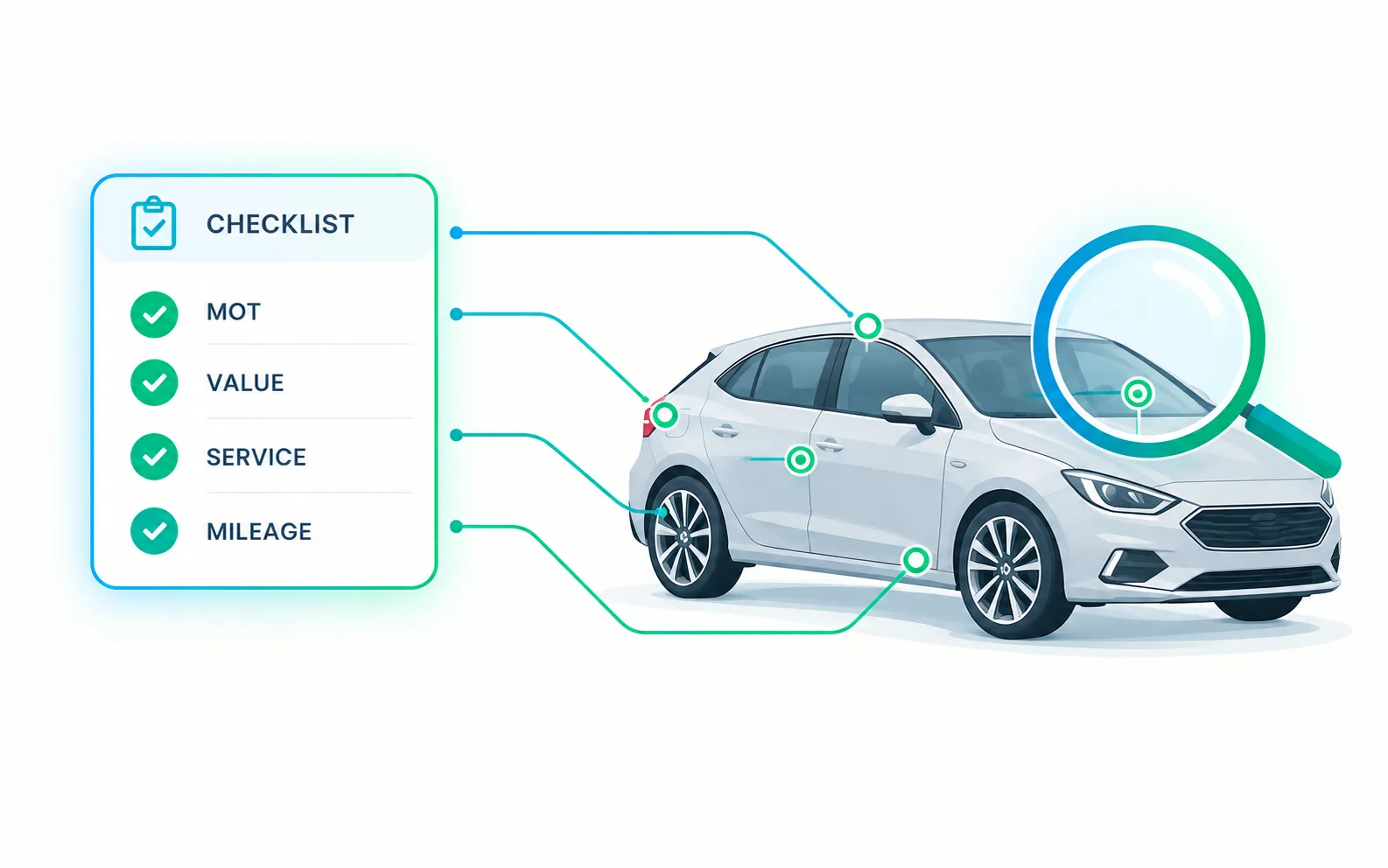
The smartest checks happen before you leave the house. With nothing but the registration, you can rule out most bad cars in ten minutes:
MOT history - advisories, failures, and whether the recorded mileage adds up.
True market value - what it’s actually worth in its condition - so you know if the price is fair.
Service history - a full, documented record is one of the strongest signs of a well-kept car.
Build & specification - the exact trim, engine and factory options - what the car actually is, not just the model name.
Mileage consistency - does the odometer story make sense across every recorded test.
Owners & plate changes - a lot of owners, or a recent plate change, is worth a question.
Walk away early
The exterior walkaround
View the car in daylight and dry weather - rain and dusk hide scratches, dents and dull paint. Then work slowly around it:
Panel gaps - even and consistent - uneven gaps hint at past accident repair.
Paint match - different shades panel-to-panel suggest a respray covering something.
Rust - check arches, sills and door bottoms. Surface rust is cosmetic; structural rust is expensive.
Tyres - legal tread is 1.6mm (aim for 3mm+), with even wear and matching brands across an axle.
Glass & lights - windscreen chips spread; condensation inside a light means water is getting in.
Bring a fridge magnet
Inside the car
The cabin is where a car's real age and history show through, whatever the odometer says:
Wear vs mileage - a “30,000-mile” car with a shiny wheel, worn pedals and sagging seats is telling you something.
Warning lights - on ignition every warning light should appear then go out - one that never lights may have been disabled.
Electrics - windows, locks, climate control, infotainment, heated seats - try every button.
Smell - damp or musty air can mean water ingress from a leak, or a flood-damaged car.
Service records - stamps, invoices and cambelt changes that line up with the MOT dates.
Under the bonnet & the test drive
Numbers on a screen can't tell you how a car actually runs. This is the part you can't skip:
Start it cold - a warm engine hides a difficult start. Blue smoke = burning oil, white = head gasket, black = fuelling.
Check the fluids - oil level and colour, coolant, and no mayonnaise-like gunk under the oil cap.
Drive it properly - 15+ minutes on mixed roads, radio off - listen for knocks, whines and vibration.
Gearbox & clutch - smooth changes, a clutch that bites cleanly, no crunching; an auto that shifts without jerking.
Brakes & steering - the car pulls up straight and tracks straight, with no vibration through the wheel.
Never buy without driving it
Paperwork & provenance
The documents are where cloning, theft and a hidden past come unstuck. None of this is visible in the metal:
The V5C logbook - the seller’s name and address must match. Never buy a car without it.
VIN match - the VIN on the V5C must match the car (windscreen base, door pillar, under bonnet). A mismatch means cloned or stolen.
Two keys - replacement keys are surprisingly expensive - factor it in if there’s only one.
The paper trail - owners and mileage on paper should match the digital MOT record exactly.
Let the data do the heavy lifting
Most of Step 1 - decoding the MOT, checking the mileage story, valuing the exact car, and pulling the service history and mileage record - takes seconds with AnalyzeMyCar. Enter the registration and you get:
Full MOT history, decoded - advisories, failures and mileage consistency in plain English.
True market value - for the exact car - adjusted for its mileage, specification and condition.
Mileage & service-history markers - the record checks that aren’t visible on the car.
AI Visual Assessment - upload photos for part-by-part repair costs, deducted from the value.
A full report is roughly £10 (10 credits), and your first one is free. Against a used-car mistake that can run into thousands, it's the cheapest insurance you'll buy in the whole process. See pricing, or browse real data on any model in CarParc.