
How MOT defects are graded
Since 2018, testers sort problems into four types:
| Type | What it means | Result |
|---|---|---|
| Dangerous | A direct risk to road safety or the environment | Fail - don't drive until repaired |
| Major | Could affect safety or the environment | Fail - repair it straight away |
| Minor | No significant effect on safety | Pass, but repair it soon |
| Advisory | Could become a problem later | Pass, keep an eye on it |
The most common reasons cars fail
Most failures fall into a handful of categories - and many are things you can check yourself before the test:
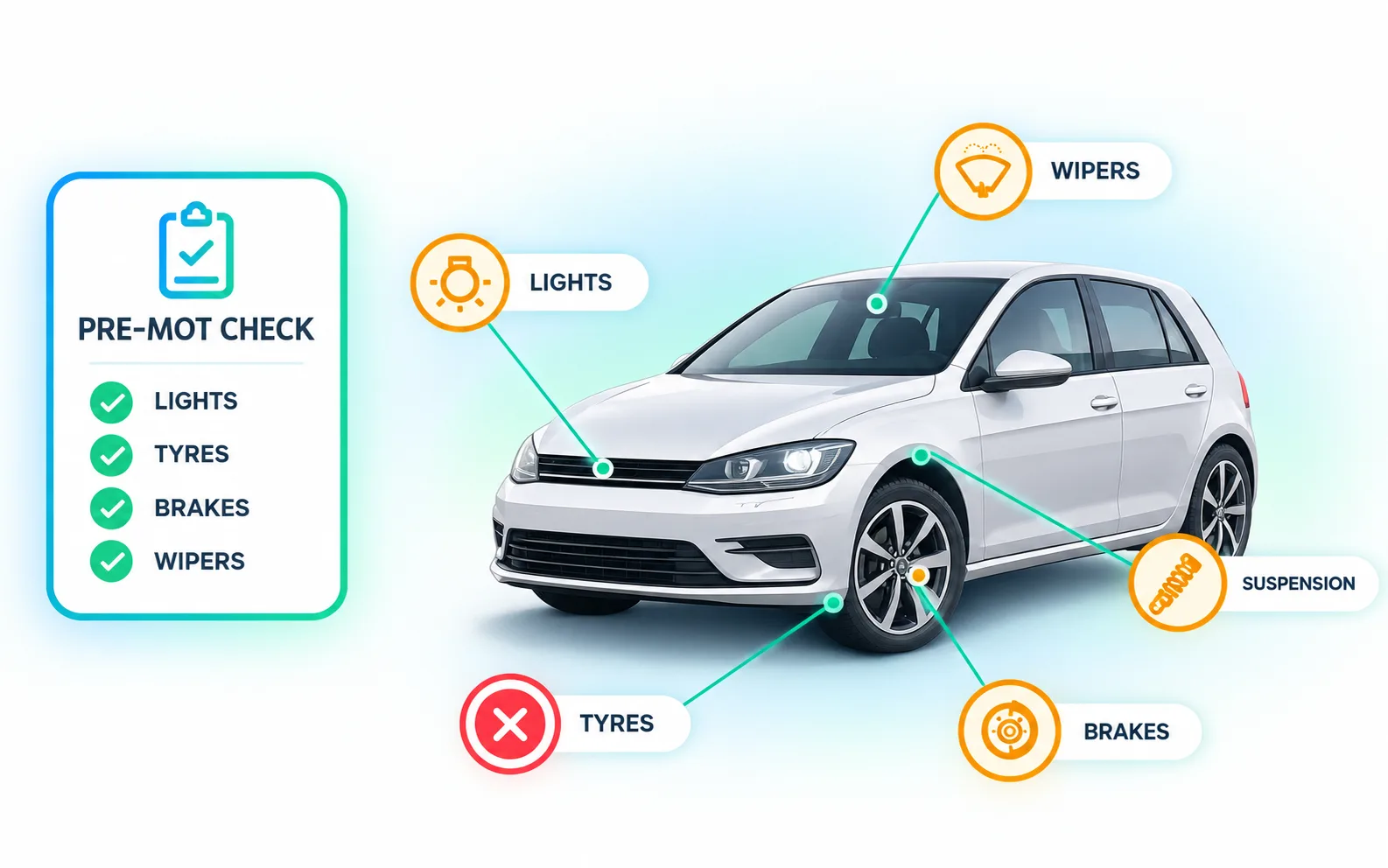
Lights and signalling - Blown bulbs, cracked lenses, headlights aimed wrongly and a missing number plate light. Most are cheap and quick to fix.
Check yourself: walk round the car with someone pressing the brake pedal and working every light, including indicators, reversing lights, fog lights and the number plate light.
Suspension - Worn or broken springs, leaking shock absorbers and worn joints and bushes.
Check yourself: listen for knocks and clunks over bumps. Push down hard on each corner: the car should bounce back once and settle.
Brakes - Worn pads and discs, uneven braking, a weak handbrake and brake warning lights.
Check yourself: does the car pull to one side when you brake? Any grinding, squealing or a soft pedal? Does the handbrake hold the car on a slope?
Tyres - The legal minimum tread for cars is 1.6mm across the central three-quarters of the tyre, all the way round. Cuts, bulges and exposed cords also fail.
Check yourself: use a tread depth gauge, or the 20p test: if you can see the outer band of the coin in the groove, the tread may be close to the limit.
Driver's view of the road - Windscreen damage, worn wiper blades and empty washer fluid. A chip larger than 10mm directly in front of the driver can fail, as can damage over 40mm elsewhere in the area the wipers clear.
Check yourself: top up the screen wash, replace streaky wipers and get chips repaired early, often at low or no cost through your insurance.
Other easy fails to avoid
- Warning lights left on, such as the engine management or airbag light
- A horn that doesn't work
- Damaged or dirty number plates, or ones with the wrong font or spacing
- Seatbelts that don't lock or retract properly
- Objects that block your view, such as large dashboard ornaments or a sat nav in the wrong place
Your 10-minute pre-MOT checklist
Run through this before the test - it catches the cheap, avoidable failures:
- All lights and indicators work
- Tyres above 1.6mm with no cuts or bulges
- Wipers clear the screen without streaks
- Screen wash topped up
- No chips or cracks in the driver's line of sight
- Horn works
- No warning lights on the dashboard
- Number plates clean and legible
- Seatbelts lock and retract
- Brake, oil and coolant levels topped up
Advisories are a warning, not noise
Useful MOT facts
- You can take your MOT up to a month (minus a day) before it runs out and keep the same renewal date.
- Driving without a valid MOT can lead to a fine of up to £1,000, unless you're driving to a booked test or to repairs.
- Advisories are not just paperwork - the same advisory year after year often turns into a fail.
Buying a used car? Read its MOT history first
A car's MOT history shows how it has been looked after. Repeated advisories for corrosion, brakes or suspension can mean big bills ahead. An AnalyzeMyCar report lays out every test, highlights repeat advisories and checks the recorded mileage, so you can see the warning signs before you buy. Learn how to read it in Understanding MOT History, then work through what to check when buying a used car.
Run a car history check by reg, or see a sample report first.
A full report is roughly £10 (10 credits), and your first one is free. See pricing, or browse real MOT and reliability data on any model in CarParc.