
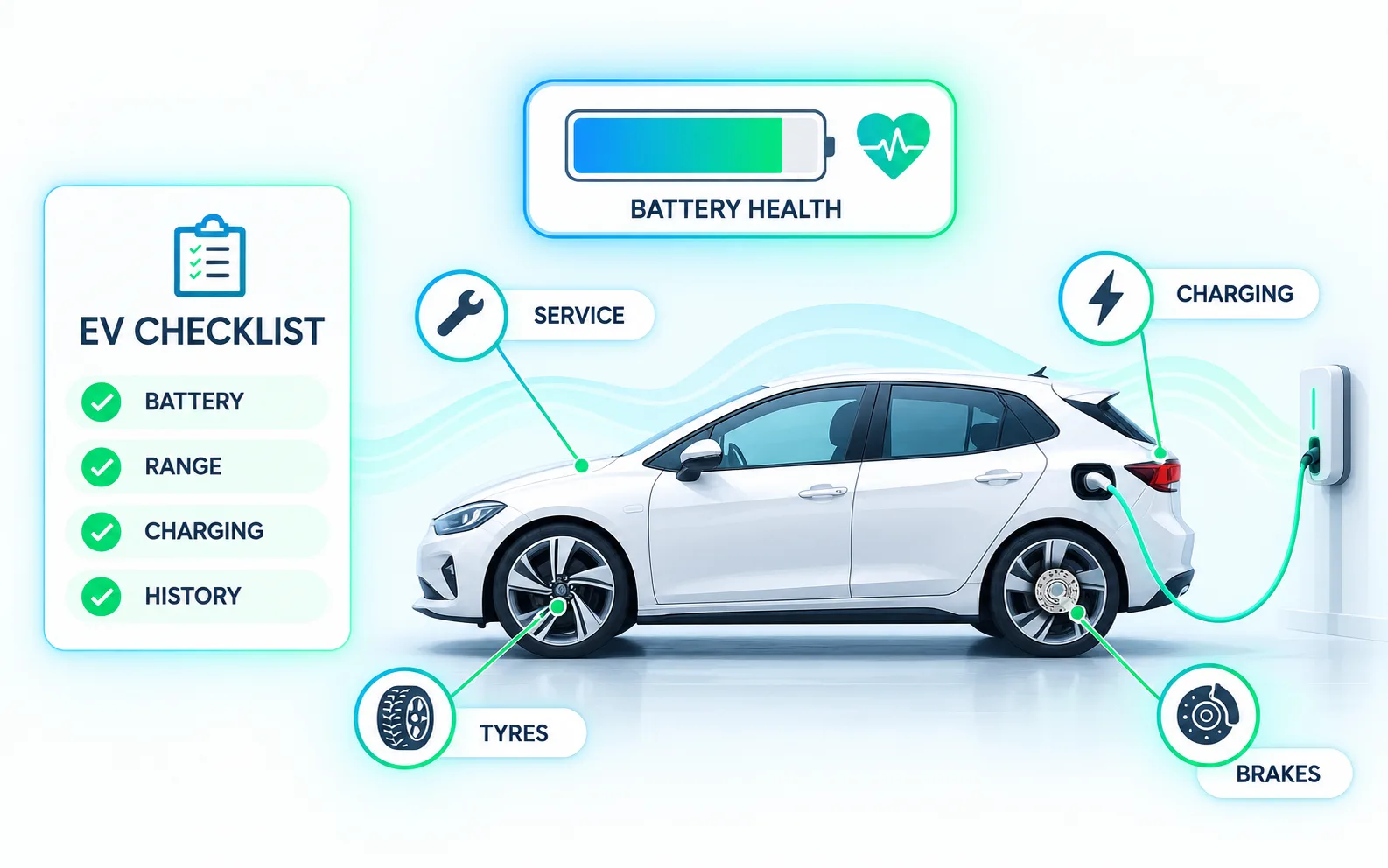
First, know which type you're buying
| Type | How it works | What matters most |
|---|---|---|
| Full electric (EV / BEV) | Battery only, plugs in to charge | Battery health, range, charging |
| Plug-in hybrid (PHEV) | Petrol or diesel engine plus a battery you plug in | Battery, charging and engine servicing |
| Self-charging hybrid (HEV) | Engine plus a small battery charged while driving | Engine servicing and hybrid system checks |
| Mild hybrid (MHEV) | Mostly a normal engine with a small electric boost | Treat it mostly like a petrol or diesel car |
The seller's advert may simply say “hybrid”. Check the exact version, because it changes what you're buying - and what you need to inspect.
Battery health
All batteries lose some capacity with age and use. The question is how much:
Ask for a battery health report - often called “State of Health” or SoH. Many main dealers and EV specialists can produce one.
Check the battery warranty - many manufacturers cover the battery for around 8 years or 100,000 miles, but terms vary - check the exact cover and whether it transfers to you.
Compare real range with the official figure - charge to 100% if you can and look at the predicted range. Expect it to fall in cold weather.
Charging
- Test both home-style (AC) charging and rapid (DC) charging if the car supports it.
- Check the charging port and flap for damage or corrosion.
- Make sure the charging cables come with the car - a replacement cable can cost a few hundred pounds.
- Find out the car's maximum charging speed. Two versions of the same model can charge very differently.
Tyres and brakes
EVs and hybrids need specific checks here, and the MOT history will often show the problems:
Tyres - EVs are heavy and quick off the line, so tyres can wear faster. Check the tread on all four.
Brakes - regenerative braking means the brakes are used less, so discs can rust and callipers can seize. Look for MOT advisories mentioning corroded discs or uneven braking.
Service history, software and recalls
- EVs need less servicing, but they still need it: brake fluid, cabin filter, coolant for the battery, and checks on the high-voltage system.
- Hybrids also need normal engine servicing.
- Ask whether software updates have been done - they can improve range and charging and fix known faults.
- Main dealer records are the best proof that the work was done properly.
- Check whether the car has any open safety recalls, and ask the seller for proof any recall work was completed.
Spec, tax and running costs
Battery size and options - the same model can come with different battery sizes, a heat pump (which helps winter range) or faster charging. Check exactly which version you're getting.
Vehicle tax - since April 2025, electric cars pay vehicle tax like other cars, and more expensive models may pay an extra yearly supplement. Check the rate before you buy.
Insurance - EVs can cost more to insure. Get a quote before you commit.
Test drive checklist
- Car switches on and is “ready to drive” with no warning messages
- Predicted range is reasonable for the car's age and the weather
- Heating and air conditioning work (they affect range)
- Regenerative braking feels smooth and the car brakes evenly
- No knocks over bumps (heavy cars wear suspension parts)
- Charging cable included and the car accepts a charge
- For hybrids: the engine starts and stops smoothly when switching between modes
The battery won't show on a quick spin
Check the history before you view
An AnalyzeMyCar report shows the MOT history (including tyre and brake advisories), main dealer service history where available, the factory build sheet so you can confirm battery size and options, and a market valuation - so you know whether the car has been cared for, and whether the price is fair. It pairs well with our used-car buying checklist and Understanding MOT History.
Run a car history check by reg, or see a sample report first.
Your first full report is free. See pricing, or browse real EV and hybrid data on any model in CarParc.